At the heart of the story: the studio’s art director’s journey to Porcelanosa Grupo
Our art director has just returned from Spain, where, at the invitation of Porcelanosa Grupo and Ukrainian partner Agromat, she had the opportunity to see the ceramic world from the inside – literally. It was not just a professional trip, but an experience that leaves behind a new sense of material, technology and aesthetics.
Showroom as an instrument of sensation
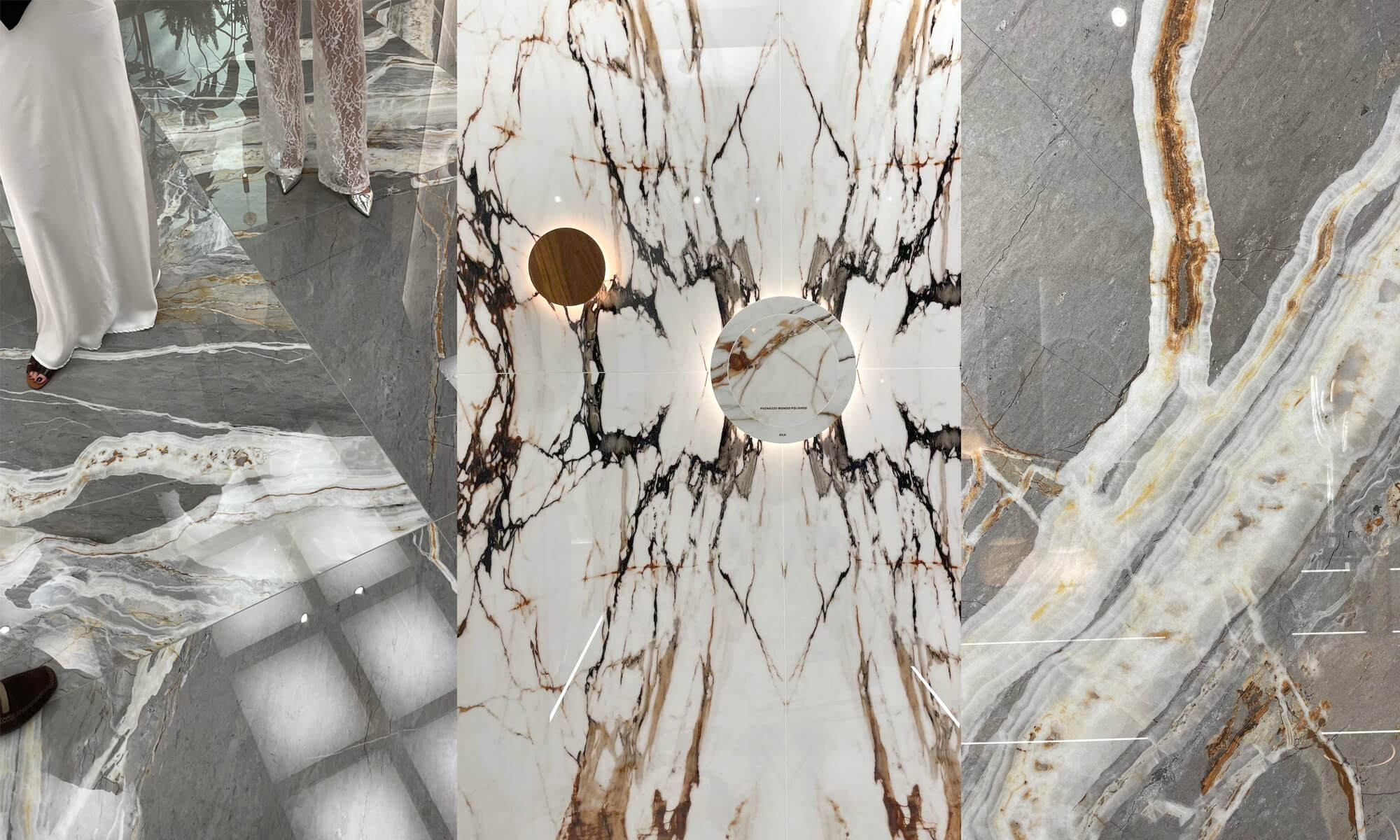
Porcelanosa Grupo is not just one factory, but a whole universe of brands. We visited showrooms that impress not only with their scale but also with the way they help you see the tiles in a ‘live’ interior. Everything here is covered with porcelain stoneware: walls, floors, furniture. There are no paints, wallpapers or plasters. It is a complete immersion in the potential of the material.
Each collection is the result of in-depth research. At Porcelanosa, they study natural stone in the smallest detail: they go on expeditions, take pictures of cracks, shadows, and the depth of the pattern – to transfer all this to tiles. And the result is truly impressive: some marbles and onyxes are so realistic that you have to touch them to make sure they are not stone.
A material with character and possibilities
But beauty is not the only advantage. The material is hardy and practical: the tiles are scratch-resistant, resistant to moisture and chemicals, have a protective coating and a thin thickness. It is used not only for cladding, but also for countertops, washbasins, stairs, decorative panels, and bathtubs. In addition, the factory can engrave the customer’s own logo free of charge – it’s about individuality at a new level.
Special respect goes to technology. Porcelanosa is the first to receive new equipment from the manufacturer, and other factories buy up the previous one in turn. They create long tiles with perfect geometry – they can be laid with an offset of ½ without drops, which is often not possible for other brands.
Porcelanosa production as an art form
We walked more than 9000 steps through the production and main showroom – it’s like a small city. It is important that even here they did not forget about a detail: before the full-scale invasion, Porcelanosa used white clay from the East of Ukraine. Now it uses Spanish clay, but the Ukrainian trace is preserved in the company’s history.
The real interest is in the laboratory area, where not everyone is allowed. This place is like a separate world. Here, every batch of tiles is subjected to rigorous testing. Visually, it’s a small room, but what happens there is impressive.
The tiles are scratched with sand, imitating years of use. It is covered with aggressive dyes, chemicals and acids, leaving it for a day to check the reaction of the surface. The material is subjected to freezing and sudden changes in temperature and pressure to determine at what point the tile will crack or change its appearance.
After all these tests, we saw the results in comparison with tiles from another, cheaper manufacturer. The difference is striking. Competitive tiles are scratched, faded, deformed. Porcelanosa – almost unchanged. All this demonstrates not just quality, but the brand’s deep responsibility to architects, designers and the end user.
Production as a separate architecture
The most interesting part is the closed testing area. Each batch of tiles is tested: scratched with sand, filled with chemicals, subjected to temperature changes, and pressed with weight. After all this, Porcelanosa tiles hardly change. But competitive tiles are already losing their appearance. This is the case when quality does not require advertising – it is proven by experience.
A new level of plumbing
The final chord was the Noken factory, which specialises in sanitary ware. Every faucet, shower, and toilet is connected to water, and everything works right in front of your eyes. The brand is not yet well represented in Ukraine, but it has great potential. Their coloured washbasins, stone anti-slip trays, and bathtubs are aesthetics in action.
We also saw the Lantic Colonial brand, which works with natural stone. Its collections include washbasins, bathtubs, tiles, mosaics and stone veneers. Here, the natural texture becomes the basis of the design: rough stone is transformed into exquisite shapes. Lantic Colonial items are a balance between the brutality of the material and delicate handcraftsmanship. For interiors where you want the real thing – with character, depth and natural aesthetics.
An experience that changes the practice
This trip was not just a new experience, but a professional investment in the future of our interiors. To see the process of creating a material from the inside means to start feeling and using it differently. That’s why we choose materials that go through not only the production cycle, but also the test of time, meaning and respect for design.