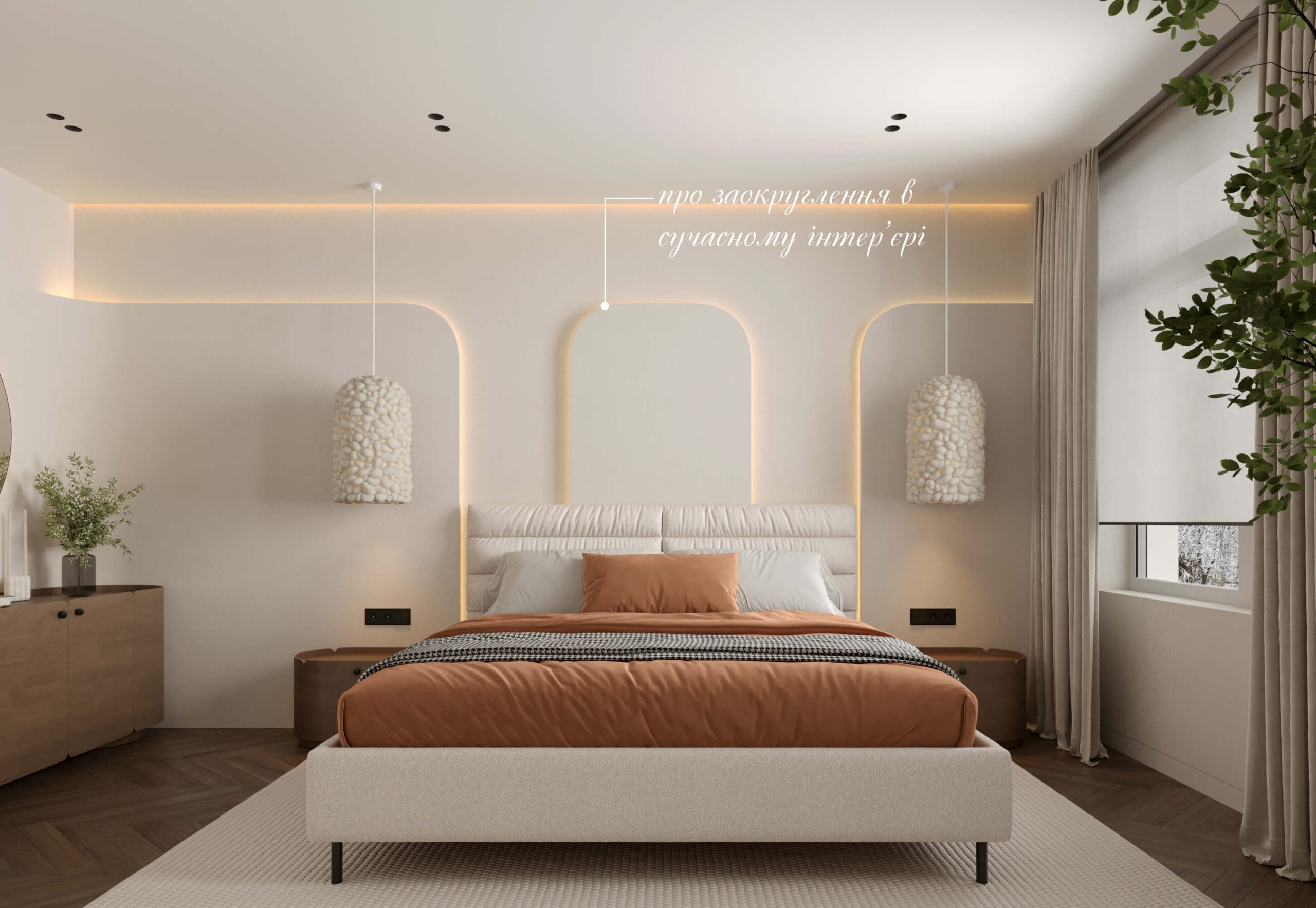
Soft shapes – soft space: how roundings change the interior
In the interior design of recent years, there has been a clear trend towards softer shapes. While sharp angles, straight geometry and strict linearity used to be synonymous with modernity, today designers are increasingly opting for rounding – delicate, smooth lines that create a completely different rhythm for the space.
This is more than an aesthetic solution. It is a way to change the atmosphere – to make it warmer, calmer, more tactile and organic. This approach resonates with the demand of the times: in a world of overload, tight deadlines and information noise, we are looking for not just a stylish interior, but a safe space for recovery.
A space that doesn’t press
Rounded shapes work not only at the level of decor. They change the very feeling of space – visually, emotionally, physically. Smooth lines gently guide the eye without stopping it at hard transitions and create a sense of flow. The space becomes ‘breathing’ – the kind of space you want to be in slowly, bodily, consciously.
On a subconscious level, we perceive rounded corners as safe. The human brain evolutionarily associates soft shapes with natural objects, with the absence of threats. Therefore, an interior with rounded corners, arches and oval elements literally calms the nervous system.
Soft shapes in architecture
Designers are increasingly using rounding as a planning tool. It’s not just a trend – it’s a new language of architecture where shape matters. Among the common techniques:
- Instead of traditional openings, the arches are modern, elongated, and sometimes asymmetrical. They not only serve as a transition between spaces, but also become a visual accent.
- Plasterboard structures allow you to form rounded niches, volumetric panels, and rounded partitions. Flexible frames and finishing coatings create smooth and clean lines.
- Walls with a radius end are an alternative to sharp corners in the layout. Rounding in the corners of the room or at the entrance to the room softens the architectural structure.
- Built-in lighting – illumination along curved lines enhances the effect of softness, adding depth to the shape and additional emotionality.
Furniture and details in the interior
The softness of the interior is also enhanced by the shapes of furniture and decor. They are increasingly used:
- Radius furniture – cabinets with rounded facades, tables without sharp corners, oval sofas.
- Luminaires of natural shapes – ‘cloud’ light objects, volumetric sconces, drop lamps – not only illuminate, but also create visual lightness.
- Textiles and carpets with soft lines – without rigid geometries, with shapes that repeat the natural rhythm – waves, ovals, circles.
These details make the interior ‘alive’ – one that you want to touch with your eyes and hands.
Organic zoning
Another reason for the popularity of rounded edges is their ability to zone the space without rigid divisions. Instead of clear boundaries, there are smooth transitions between zones: from the kitchen to the living room, from the bedroom to the dressing room, from the common to the private. This is especially important in small spaces or open space layouts, where you want to maintain openness but also outline functionality. Rounded partitions, half-walls, rounded entrance lines – all this works as a natural division without creating a sense of pressure.
Despite its visual softness, rounding is a powerful design technique. It changes the character of the space, creates a sense of security, and reduces visual noise. And although it is currently in fashion, the point is not in the trend – the point is in the meaning. This is an aesthetic that speaks of respect for the body, for the psyche, for the rhythm of life.
In times of turbulence, we are looking not only for beautiful things, but also for spaces that protect us. And rounding is precisely the tool that forms not a style, but a state. A space where you want to live slowly and truly.
More about the project
Light, soft, cosy – this bedroom in modern minimalism with notes of Scandinavian style is designed for tranquility. The main palette – white, cream and beige – is complemented by terracotta textiles and a contrasting black and white blanket. The soft headboard echoes the rounded shapes of the furniture, avoiding rigid geometry. The herringbone floor, warm wood in the texture of the cabinets and chest of drawers – everything works for a sense of naturalness. Arched niches with lighting, textured panels, pendant lamps are details that create character.
Design @gl.design_studio
Project: Warm Harmony, Lavender Residential Complex, Brovary
Area: 16.02 sq.m.
____
🔹 Interior design in Ukraine and abroad 🌎
🔹 Let’s discuss your project! Write to us in private messages ✉️
🔹 call 067 1234 144📱
🔹 design-gl.com