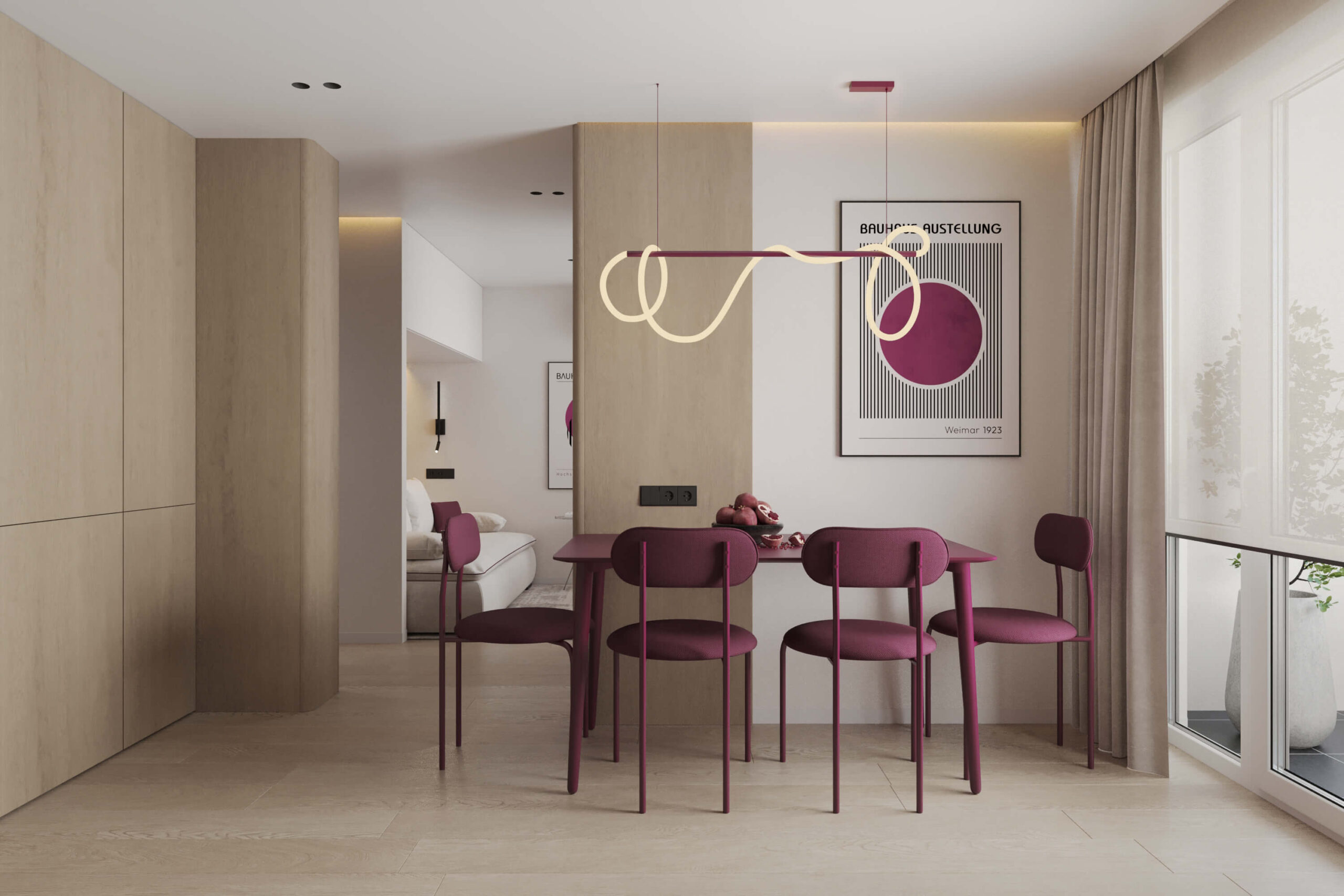
Bright accents in the interior: how coloured elements enliven the space
Modern interior design is increasingly inclined towards functionality and restraint, but bright accents remain an indispensable tool for creating an expressive space. One of the most effective ways to add personality to an interior is to use coloured elements: accent chairs, tables, decor or even a single wall in a rich shade. Let’s take a look at how to integrate bright colours into the interior so that they become not just a detail, but an organic part of the composition.
Why does the interior need colour accents?
Bright elements in the interior perform several important functions:
– They create dynamics. In minimalist spaces, one bright object can completely change the mood of the room.
– Form a style. Red chairs can add courage to the kitchen, and a turquoise sofa will make the living room look modern and stylish.
– Highlight zones. For example, yellow chairs at the dining table will help to visually separate the kitchen and living room in a studio space.
– Add emotion. Colour has a significant psychological impact: blue calms, red stimulates activity, and green creates a sense of harmony.
How to use bright colours correctly?
To make accent elements look harmonious, you should consider a few design rules:
- Choosing the main colour
When choosing an accent colour, it is important to consider the overall interior palette. For example, rich shades such as pink, mustard, and emerald will work well in light or neutral interiors. In dark spaces, contrasting details look spectacular: a white table or orange chairs. - Colour balance
There is a 60-30-10 rule: 60% of the space is occupied by the main colour (walls, floor), 30% by an additional colour (furniture), and 10% by accents. For example, if the interior is built on shades of grey, then pink or cobalt chairs can become the 10% that will enliven the space. - Style and concept
Monochrome spaces with bright furniture look good in modern minimalism. The Scandinavian style is characterised by pastel accents, and in Art Deco, you can safely use deep, rich colours: burgundy, sapphire, gold. - Materials and textures
Glossy surfaces enhance the effect of bright colours, while matte surfaces make them more restrained. For example, velvet emerald armchairs will look more elegant than the same ones in patent leather.
Where and how to use accent elements?
- Kitchen and dining room: coloured chairs, bar stools, aprons, lamps.
- Living room: bright sofa, coffee table, large paintings, pillows.
- Bedroom: coloured bed upholstery, textiles, poufs.
- Children’s room: rich colours of furniture, wallpaper, toys.
- Hallway: accent wardrobe, contrasting doors, mirrors in bright frames.
Bright accents in the interior are an effective way to revive the space, make it unique and stylish. The main thing is to find a balance, using rich shades in a dosed and thoughtful manner. Let the interior reflect your personality and bring aesthetic pleasure!
More about the project
Colour in the interior: do not be afraid, but use it skilfully! In this project, we focused on space and functionality, but did not forget about colour solutions. In the hallway, we placed a hanging wardrobe that adds lightness, and mirrors on and above the doors visually expand the space. The kitchen is spacious, with plenty of storage space. But its real highlight is a bright dining table with coloured chairs and a pendant lamp. An interesting shade is also found in the poster, which harmoniously complements the concept. Unusual, complex shades in accents can make an interior stylish, unique and full of character.
Design by GL design and Architecture Studio
Project: Bright accent, Lysynychi village, Lviv region, ECO-DIM on Trakt
Area: 23.09 sq.m.