Features of designers’ measurements at the facilities: The importance and process of accurate measurements in interior design
Measurements are one of the most important stages in the work of an interior designer, which determines the success of further design and implementation. Accurate measurements help to create a comfortable and functional space, avoid mistakes and achieve the desired result in the project. Let’s take a look at why it is important to take accurate measurements on objects, what tools designers use, and what features of the process should be taken into account.
Why are measurements so important for an interior designer?
Before starting to create an interior design, a designer must obtain accurate data about the space. This is necessary in order to properly plan the arrangement of furniture, lighting, zoning and other important details. Without accurate measurements, the designer may face problems such as the wrong size of furniture, too narrow aisles, or mismatches between interior elements.
Measurements not only help to avoid mistakes, but also make it possible to take into account all the nuances of the space: architectural features, uneven walls, floor level, etc. Knowing these parameters gives the designer the opportunity to create the most accurate and realistic plans that take into account the specifics of each object.
Tools for measurements
Designers use a variety of tools to take measurements to ensure the accuracy and speed of measurements:
1.Laser rangefinders
These are one of the most common tools for measuring. They allow you to measure distances between points with millimetre precision, as well as to determine areas and volumes. A laser rangefinder is particularly useful in spacious rooms where manual measurement would be difficult.
2. Measuring tape
This is a traditional tool that is still used in many facilities. It is versatile and convenient for accurate measurements of short distances. Measuring tapes can be digital or mechanical, but the most important thing is that they allow you to record accurate data, even in non-standard conditions.
3. Technical drawings
For more complex objects, such as multi-storey buildings or rooms with unusual geometries, designers can use special drawings and diagrams to accurately display all measurements.
4. 3D scanners
This is the latest technology that allows you to create a three-dimensional model of a room. With a 3D scanner, you can get accurate measurements and even collect data on textures, materials, and other important characteristics of the space.
Features of measurements on different types of objects
The measurement process can vary significantly depending on the type of object and its features. Let’s take a look at some of the things to consider when measuring different types of premises.
1. Residential premises
In apartments, houses, or other residential properties, designers often encounter uneven walls and floors, which makes measuring even more important. Taking into account small details, such as wall ledges, niches, door and window openings, allows you to create a more comfortable and functional environment. The height of the ceilings should also be taken into account, as this affects the ability to use different types of furniture, lighting and decor.
2. Commercial premises
For offices, shops, restaurants and other commercial facilities, measurements become even more important. Here, you need to take into account not only the aesthetic component, but also the functionality of the space. Accurate measurements help to design the layout to ensure maximum comfort for employees or customers, efficient use of space, and optimal placement of furniture and equipment. In commercial premises, it is also important to take into account the specifics of lighting and ventilation, which requires special attention during measurements.
3. Architectural and historical objects
Measurements on ancient or historical objects require special skills and tools. Here, designers must not only obtain accurate data about the space, but also take into account the specifics of materials and structures to preserve the authenticity of the architecture. In such cases, modern technologies, such as 3D scanning, are used to capture all the details and features of the object as accurately as possible.
Measurement procedure: stages of the process
The measurement process consists of several stages, including both preparatory work and the actual measurements:
- Preparation for measurements. At this stage, the designer studies the object’s design, defines the main goals and objectives, and selects the necessary tools for measurements.
- Preliminary measurements. Basic measurements of the premises are carried out to understand the general parameters of the object.
- Detailed measurements. At this stage, accurate measurements are made of all elements: walls, doors, windows, floors, ceilings, etc. Attention is also paid to specific details, such as ledges, niches, openings, and other design features.
- Creation of drawings. After taking measurements, the designer creates drawings that reflect all the data obtained. These can be both two-dimensional and three-dimensional models of the room.
- Analysis and adjustments. Based on the data obtained, the designer conducts an analysis and makes the necessary adjustments to achieve the best result
Measurements are the basis for successful interior design. The accuracy of measurements determines the quality and efficiency of the future interior, so this process should not be underestimated. The use of modern tools and technologies, as well as an experienced approach to working with each object, allow designers to achieve high results and create comfortable and functional spaces.
More about the project
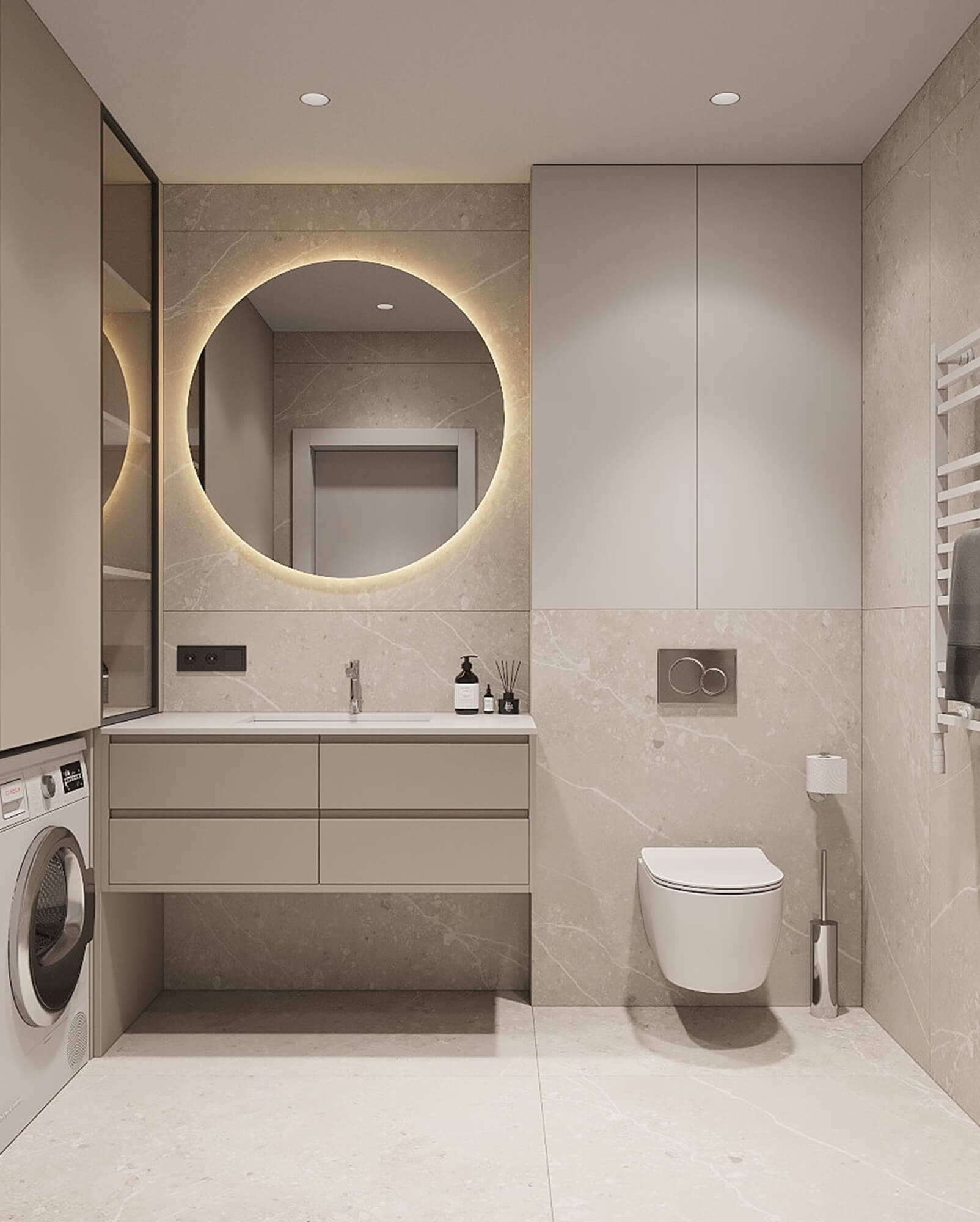
A modern bathroom that has been designed with style in mind. Light neutral palette, beautifully integrated washing machine and dryer, illuminated glass shelves – all for convenience and visual harmony. A hanging cabinet, a round mirror and a shower with a transparent partition make the space light and airy. Solutions that work for comfort and look are exactly what we love to create.
Design @gl.design_studio
Project: Calm and lightness, Viking Park, Lviv
Area: 6,6